
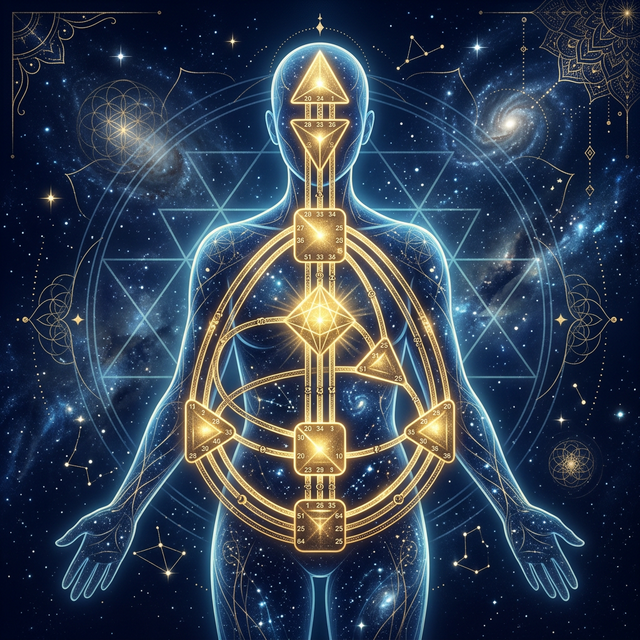
Human Design is not a belief system. It doesn’t ask you to believe anything. It is a logical, empirical system that you can test for yourself.
By combining the I Ching, Astrology, Kabbalah, and the Hindu-Brahmin Chakra system along with Quantum Physics and Genetics, Human Design provides an incredibly accurate map of your unique energetic blueprint.
The Bodygraph: Your Personal Map
At the core of Human Design is the Bodygraph. This intricate diagram maps out exactly how your energy operates. Unlike traditional astrology which focuses primarily on the zodiac and planetary placements, Human Design integrates these placements into the energetic centers of the body.
Here are the primary components of the Bodygraph:
1. The 9 Energy Centers
These are an evolution of the traditional 7-chakra system. Each center governs a biological function and an energetic theme, from inspiration to willpower to emotions.
2. The 64 Gates
These correspond to the 64 Hexagrams of the I Ching as well as the 64 codons of our DNA. When a planet is in a specific Gate at your time of birth, that gate is "activated" or colored in on your chart.
3. The 36 Channels
When two activated Gates connect between two Energy Centers, they form a Channel. Channels indicate consistent, reliable themes and gifts in your life.

For a practical walkthrough of every element in the diagram, see our step-by-step guide: How to Read Your Human Design Bodygraph.
Why is it so powerful?
Human Design allows you to stop living according to conditioning. Every person is born completely unique, yet we are heavily conditioned to act the same. We are told to "just do it," but that advice assumes everyone operates the same way.
By learning your Type, Strategy, and Authority, you can tap into a decision-making process that completely honors your truth, eliminating resistance and leading to a life of fulfillment, success, peace, or surprise.
Ready to discover yours? Head over to our Free Human Design Calculator to generate your chart instantly!
Continue Learning
- Ra Uru Hu: The Founder of Human Design — the origin story behind the system
- Human Design vs Astrology — how the two systems overlap and differ
- Quantum Human Design Explained — a modern re-languaging of the original mechanics
- Human Design 2027 — the Global Cycle shift from the Cross of Planning to the Sleeping Phoenix
